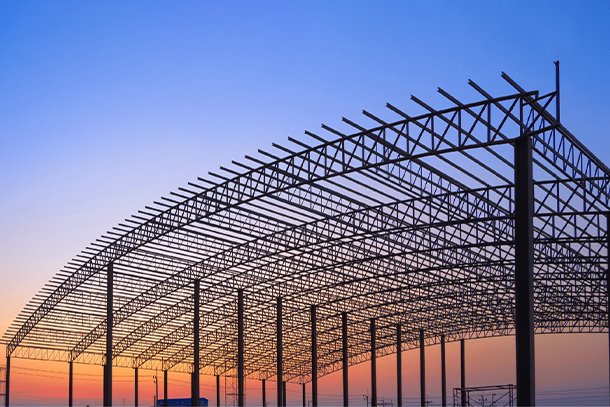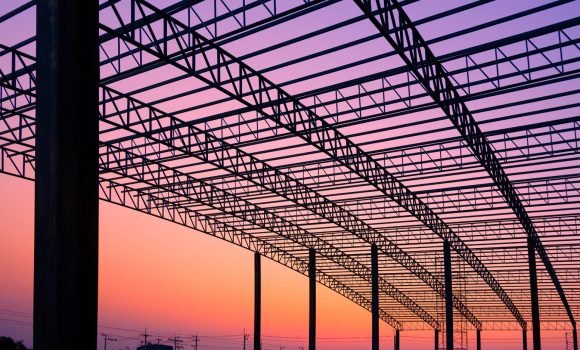

Primary Members / Main Frames
Primary frames are designed in accordance with the Steel Construction Manual published by the American Institute of Steel Construction (AISC). Dimensional tolerances for manufacturing comply with the standards of the Metal Building Manufacturers Association (MBMA), USA, as outlined in the Low Rise Building Systems Manual.
In addition to AISC and MBMA guidelines, buildings are also designed in accordance with IS-875 (1984 and 2007 editions). Built-up sections are fabricated using hot-rolled steel plates conforming to ASTM A 572M Grade or equivalent, with a minimum yield strength of 345 N/mm² (50 ksi).
The most widely used primary framing systems are illustrated here, typically symmetrical about the ridge line. However, unsymmetrical framing systems and multi-span structures with unequal width modules can also be designed. In practice, almost any frame geometry can be constructed.
Common primary framing components include:
- Columns
- Rafters
- Canopies
- Rails
- Crane Beams
- Jack Beams
- Mezzanine Floors
Mezzanine Floors in Buildings
Intermediate mezzanine floors can be incorporated into metal buildings. These may cover the entire floor area or only a portion, depending on office or storage load requirements.
A mezzanine floor typically consists of steel decks supported by joists, which are framed into mezzanine beams. The main mezzanine beams usually run across the building width beneath the primary rafters, while joists are aligned parallel to the building length. The top flange of the joists fits directly below the top flange of the mezzanine beam, ensuring structural integrity.
The cost-effectiveness of a mezzanine floor depends largely on the applied loads and column spacing. Additionally, multi-level equipment platforms, catwalks, staircases, and other features can be accommodated when complete design data is provided.